
Case Study
Enterprise Marketplace
A structured service marketplace that connects businesses with providers while giving operators control over every transaction.
- 7 MonthsDelivery Timeline
- 13 MembersProject Team
- 4 InterfacesConnected Platforms


Project Overview
Enterprise Service Marketplace is a UAE platform built to connect businesses with service providers across multiple professional categories. Business users can create accounts, search services, compare provider information, submit requirements and manage active requests from one workspace. Providers can maintain profiles, receive enquiries, submit proposals and manage accepted work, while the operator oversees providers, transactions, users and marketplace activity through a central administration dashboard. Techanic Infotech designed the platform around the practical needs of UAE businesses that often source professional services through referrals, calls and disconnected communication. Bringing discovery, requests and fulfilment into one marketplace gives every participant better visibility.
Project Idea
The business idea was to create a digital marketplace where companies could find suitable service providers without relying entirely on personal networks or repeated supplier searches. The operator wanted to bring service discovery, business enquiries and provider management into one structured platform.
Enterprise service procurement can involve several conversations before a job is even confirmed. Businesses may need to explain requirements to multiple providers, compare responses and track follow ups across email, phone and messaging applications. Providers face a similar problem when enquiries arrive through disconnected channels and lack consistent project information.
Techanic Infotech connected business requirements with provider profiles, service categories, enquiries and fulfilment workflows. A shared marketplace structure allowed companies to submit clearer requests while providers could review relevant opportunities and respond through their own interface. The administration team could monitor marketplace activity, manage provider records and intervene when transactions required support.
The product principle focused on relevance, transparency and control. Businesses needed useful provider information before making a decision, providers needed clear requirements before responding, and the operator needed visibility into marketplace activity. The platform was therefore designed to make each step easier to understand while keeping important business actions within one system.

Challenges
The marketplace had to serve different types of business users, from small companies requesting a single professional service to larger organisations handling recurring requirements across several locations. First time users needed a straightforward route to submit a request, while experienced procurement teams expected more detailed information, saved company data and clear request status.
Service categories also varied significantly. A business looking for office cleaning would provide different requirements from one requesting equipment maintenance, IT support or facility management. Provider profiles therefore needed flexible service information, coverage areas, business credentials and capabilities without making marketplace listings difficult to compare. The request flow also needed to capture enough detail for providers to respond accurately.
Marketplace activity could increase sharply during working hours, especially when businesses submitted several enquiries around the same procurement period. The platform needed responsive search, provider filtering, request creation and dashboard activity while multiple providers reviewed opportunities. Status changes, proposals and communication also needed to remain aligned so businesses and providers were working from the same information.

Project Milestones We Achieved
| Milestone | Tasks | Timeline | Responsible |
|---|---|---|---|
| Project Discovery and Planning | Mapped marketplace workflows, defined business roles, documented provider requirements, structured service categories and prioritised core transaction flows | Month 1 | Business Analyst and Project Manager |
| UI UX Design | Designed business journeys, provider profiles, request flows, proposal views and administration dashboard interactions | Month 2 | UI UX Designer and Product Designer |
| Core Development | Built mobile interfaces, backend services, marketplace search, provider management, requests and central administration features | Month 3 to 5 | Flutter Developer and Backend Developer |
| Integrations and Testing | Connected notifications, payment services and cloud infrastructure, then tested marketplace, proposal and account workflows | Month 6 | QA Engineer and DevOps Engineer |
| Launch and Optimization | Prepared production environments, supported provider onboarding, reviewed marketplace activity and refined search and request workflows | Month 7 | Project Manager and DevOps Engineer |
Project Features
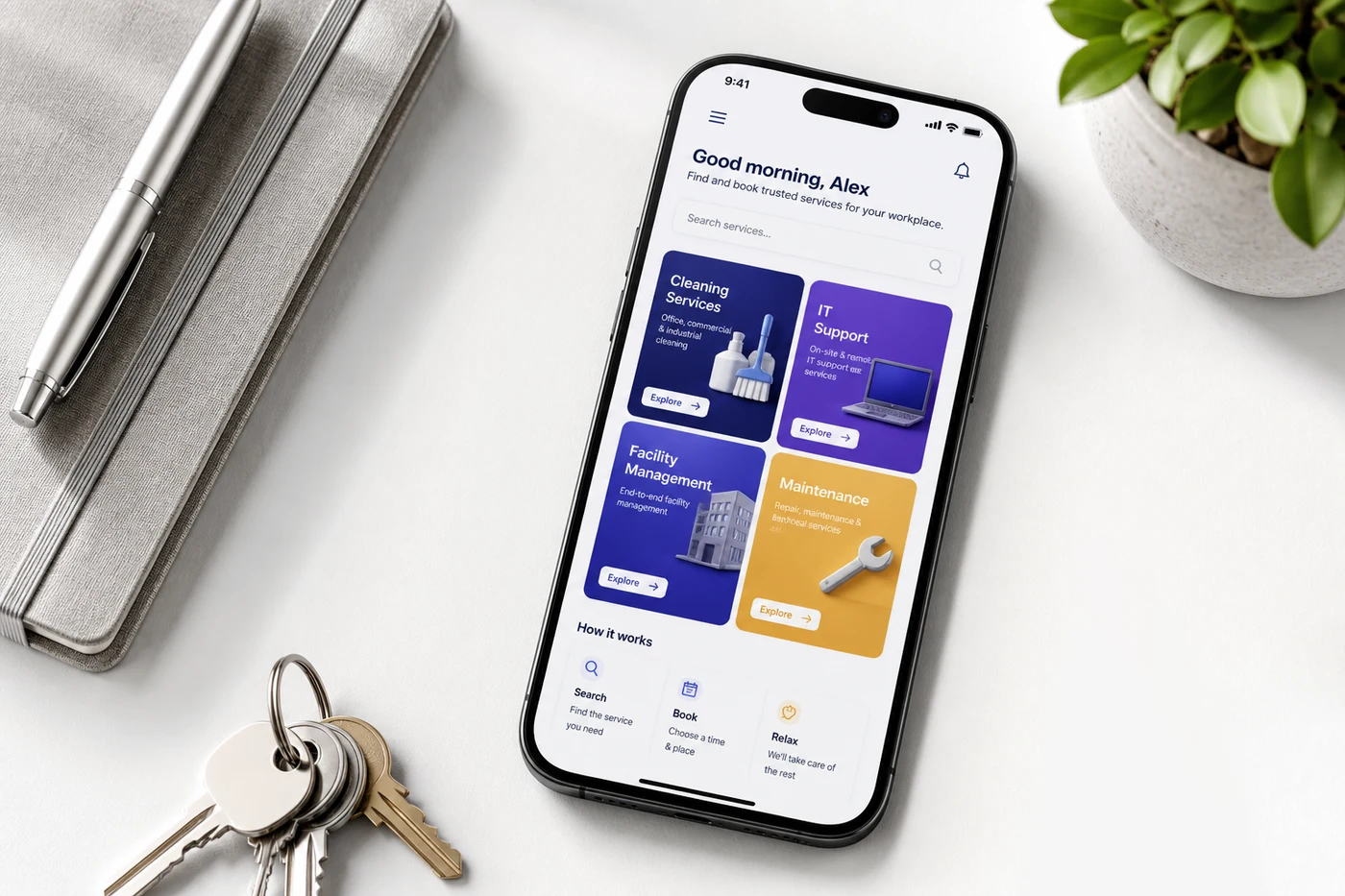
The marketplace was designed around the full business service journey, from discovering a provider to managing an active request. Separate experiences help businesses and providers focus on their own tasks, while central administration keeps marketplace activity visible and manageable.
Business Signup and Profile
Business users can create company profiles, manage contact details, save locations and maintain organisation information for faster service requests.
Service Discovery and Requests
Businesses can browse service categories, review provider information, describe requirements and submit service requests through one structured marketplace journey.
Request Status Tracking
Businesses can monitor request progress, review responses and follow important status changes without relying on separate calls or messaging channels.
Provider Matching
The platform supports provider discovery using service category, location, availability and profile information so businesses can identify relevant professionals more efficiently.
Provider Dashboard
Providers can manage profiles, review incoming requests, respond to business enquiries and track accepted work through a dedicated operational workspace.
Request History and Reordering
Businesses can review previous service requests and reuse relevant information when arranging recurring requirements or submitting similar work again.
Results
Techanic Infotech delivered an enterprise service marketplace covering business users, service providers and central administration. The launch created a structured digital route for discovering services, submitting requirements, responding to opportunities and managing accepted work across multiple professional categories.
The operator gained one marketplace dashboard for monitoring users, providers, requests and service activity. This provided clearer oversight of marketplace performance and reduced the need to reconcile provider information and business enquiries across separate channels.
Business users gained a more organised way to discover providers and communicate their requirements. Providers received clearer request information and a dedicated workspace for managing opportunities, reducing ambiguity around what a business needed and where each enquiry stood.
The platform gives the client a foundation for expanding marketplace coverage across the UAE. Additional service categories, provider groups, business account types and commercial workflows can be introduced within the existing structure, allowing the marketplace to grow without rebuilding its core transaction model.

Development Process
Explore
- UAE business behaviour
- Service procurement needs
- Provider workflow analysis
- Business journey mapping
- Provider request planning
- Marketplace process structure
Implement
- Clear category browsing
- Structured request forms
- Focused provider profiles
- Marketplace backend services
- Mobile application builds
- Administration dashboard
Execute
- Search scenario testing
- Request flow validation
- Role based testing
- Production readiness checks
- Provider onboarding support
- Marketplace activity monitoring
Typography & colors
Plus Jakarta Sans
ABCDEFGHIJKLMNOPQRSTUVWXYZ
abcdefghijklmnopqrstuvwxyz
1234567890
Primary
#4F46E5
Secondary
#818CF8
Tertiary Color
#E0E7FF
Icons Color
#1E1B4B
Text Color
#ffffff
Background Color
#ffffff
App Visuals
Al Noor Facilities
Cleaning · Dubai · 4.9Typical response
2 hoursStay up to date with request alerts
Marketplace
Verified providers nearby
You are almost there
Tech Stack
The technology stack was selected to support high traffic marketplace search, responsive provider discovery, fast request handling and a consistent mobile and web experience. Flutter powered the mobile applications, NestJS handled backend services, MongoDB stored flexible marketplace and account data, Redis supported frequently accessed search and request information, and AWS provided the cloud infrastructure for deployment and scaling.
- Flutter
- NestJS
- MongoDB
- Redis
- AWS
Have an Idea for a Scalable Platform?
Techanic Infotech can build a marketplace around your users, providers, transactions and operational requirements.
Talk to Our Experts