
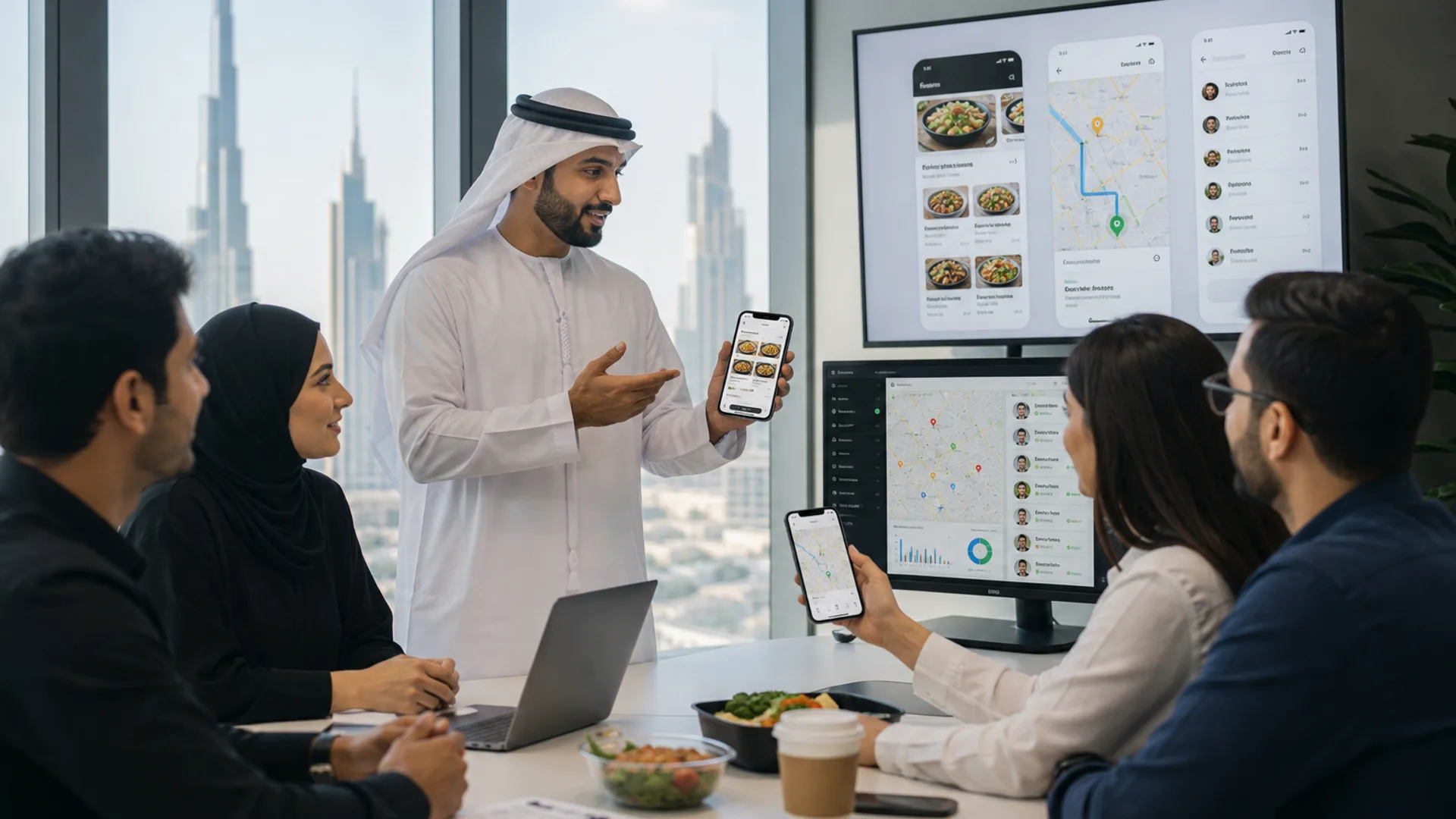
The UAE's food delivery market has exploded in recent years, with consumers increasingly relying on mobile apps to order meals from restaurants, cloud kitchens, and grocery stores with just a few taps.
As competition intensifies among platforms like Talabat, Deliveroo, and Careem, businesses and entrepreneurs are recognizing the opportunity to build custom food delivery apps that offer better commission structures, stronger brand control, and tailored customer experiences.
However, understanding the true cost of development is essential before investing, as pricing varies significantly depending on features, platform choice, and technical complexity.
This guide breaks down everything businesses need to know about food delivery app development cost in the UAE, covering essential features, detailed pricing, and the development process required to launch a successful, scalable ordering platform.
Key Takeaways
- Food delivery app development in the UAE costs between AED 20,000 and AED 140,000+, with pricing driven by the three-sided marketplace structure connecting customers, restaurants, and riders.
- Real-time GPS tracking and multi-vendor management are typically the most expensive features, given their technical complexity and need for accurate, live data synchronization.
- Starting with an MVP approach and using cross-platform frameworks like Flutter helps reduce initial costs without sacrificing essential functionality or user experience.
- Building separate apps for customers, restaurants, and delivery riders increases development scope but ensures each user group gets a tailored, purpose-built experience.
- Partnering with experienced development teams offering competitive rates and proven expertise helps businesses launch feature-rich, cost-effective platforms in the UAE's growing food delivery market.
Why UAE Businesses Are Investing in Food Delivery Apps?
UAE businesses are investing heavily in food delivery apps to capture growing consumer demand for convenient dining.
Leveraging AI development services in Dubai helps companies build personalized, efficient platforms that improve order accuracy and customer retention effectively.
Rising Consumer Preference for Convenient Dining
UAE consumers increasingly prefer ordering meals through apps rather than dining out. The online food delivery market is projected to reach USD 10.86 billion in 2026, expanding to USD 22.19 billion by 2034.
Growth of Cloud Kitchens and Digital First Restaurants
Cloud kitchens are expanding rapidly across the UAE due to lower operational costs compared to dine in restaurants.
These digital first businesses rely entirely on food delivery apps, driving significant demand for custom ordering platforms.
Reducing Dependency on Third-Party Platform Commissions
Restaurants increasingly seek to reduce reliance on costly commission-based platforms.
Food delivery orders rose 15.2 percent in the first half of 2026, with delivery now representing 30.5 percent of all restaurant orders.
Must-Have Features That Influence Development Cost
Understanding which features drive costs is essential before starting a food delivery app project.
Partnering with an experienced mobile app development company in Dubai helps businesses prioritize functionality that delivers real value while keeping the budget aligned with actual business goals and requirements.
1. Real-Time Order Tracking and GPS Integration
Customers expect live tracking showing exact delivery status and estimated arrival times.
Building accurate GPS integration with real-time map updates requires significant backend development, directly increasing overall project cost due to the complexity of location-based services.
2. Multi-Vendor Restaurant Management System
Supporting multiple restaurants on a single platform requires robust vendor onboarding, menu management, and order routing systems.
This multi-vendor architecture adds significant development complexity compared to single restaurant apps, increasing both initial cost and ongoing maintenance requirements.
3. Secure Payment Gateway Integration
Reliable custom software development in Dubai ensures multiple payment methods, including cash on delivery and digital wallets, integrate securely.
Payment processing complexity, including tokenization and fraud prevention, adds meaningful development effort and cost to the overall project budget.
4. Delivery Rider App and Route Optimization
Building a separate app for delivery riders with route optimization, order assignment, and earnings tracking adds substantial development scope.
This three-sided marketplace structure, connecting customers, restaurants, and riders, significantly increases overall complexity and total project cost.
5. Personalized Recommendations and Order History
Advanced apps use purchase history and preferences to suggest personalized menu items and restaurants.
Building recommendation algorithms and maintaining detailed order history databases requires additional backend development, increasing cost compared to basic, non personalized ordering applications.
6. Cross-Platform Compatibility and Scalability
Choosing Flutter app development in the UAE for simultaneous iOS and Android builds affects overall project cost, though it reduces long-term expenses compared to separate native apps.
Scalable architecture supporting growing order volumes also adds upfront development investment and planning.
Food Delivery App Development Cost Breakdown in the UAE
Understanding food delivery app development cost in the UAE requires breaking down expenses across each development stage.
Knowing custom software development cost in UAE helps businesses budget accurately, avoid unexpected expenses, and plan resources wisely throughout the entire project lifecycle.
1. Discovery and Planning Phase
This initial phase involves market research, competitor analysis, and defining core requirements for customers, restaurants, and riders.
Establishing a clear roadmap early prevents costly scope changes later, though thorough planning still requires meaningful upfront investment and time.
2. UI and UX Design for Multiple User Types
Designing separate interfaces for customers, restaurant partners, and delivery riders increases design complexity significantly.
Each interface requires distinct workflows and features, adding to overall design costs compared to single-user-type applications with simpler design requirements.
3. Backend Development and Database Architecture
Building robust infrastructure supporting real-time order processing, multi-vendor management, and rider coordination requires substantial backend investment.
This includes cloud hosting, database design, and API development that scales reliably as order volumes and user numbers grow.
4. Real-Time Tracking and Map Integration
Implementing GPS-based order tracking with live map updates requires integrating third-party mapping services and location APIs.
This functionality adds meaningful cost due to the technical complexity of maintaining accurate, real-time location data across the platform.
5. Payment Gateway and Multi-Method Support
Integrating diverse payment options, including cash on delivery, cards, and digital wallets, requires careful security implementation.
Tokenization, fraud prevention, and compliance measures add development complexity and cost, particularly when supporting multiple regional payment providers simultaneously.
6. Three App Development for Customers, Vendors, and Riders
Building separate applications for each user type essentially triples development scope compared to single-sided apps.
This three-app structure significantly increases overall project cost, though it ensures each user group receives a tailored, purpose-built experience.
7. Testing Across Complex Multi-Sided Workflows
Partnering with an experienced on-demand app development company in the UAE ensures thorough testing across customer ordering, restaurant fulfillment, and rider delivery workflows.
This comprehensive testing process adds cost but prevents costly post-launch issues affecting multiple user groups simultaneously.
8. Post-Launch Support and Continuous Optimization
Ongoing maintenance including bug fixes, feature updates, and performance monitoring requires continued investment beyond initial development.
Regular optimization based on real usage data ensures the platform remains competitive, though this adds recurring costs throughout the app's lifecycle.
| Feature/Stage | Description | Cost Range (AED) |
|---|---|---|
| Discovery and Planning | Market research and requirements gathering | 800-1200 |
| UI and UX Design | Interfaces for customers, vendors, and riders | 1500-2200 |
| Backend Architecture | Database setup and cloud infrastructure | 2800-4000 |
| Real Time Tracking | GPS integration and live map updates | 1800-2600 |
| Payment Gateway Integration | Multi method secure payment processing | 1600-2400 |
| Multi Vendor Management | Restaurant onboarding and menu systems | 2200-3200 |
| Rider App and Route Optimization | Delivery assignment and earnings tracking | 2000-3000 |
| Customer App Development | Ordering, tracking, and personalization features | 2500-3600 |
| Testing and Quality Assurance | Multi-sided workflow and security testing | 1400-2000 |
| Post Launch Support and Maintenance | Monthly updates, bug fixes, and scaling | 1000-1500 |
How to Optimize Food Delivery App Development Cost?
Reducing food delivery app development costs doesn't require cutting essential functionality.
Partnering with an experienced custom software development company in the UAE helps businesses identify smart strategies that lower expenses while still delivering a feature-rich, competitive platform that meets customer expectations effectively.
1. Start With an MVP Approach
Launching with core ordering, tracking, and payment features first validates market demand before adding advanced functionality.
This phased approach reduces initial investment significantly, allowing businesses to reinvest revenue into expanding features based on real user feedback over time.
2. Use Cross Platform Development Frameworks
Choosing frameworks like Flutter or React Native enables simultaneous iOS and Android development from a single codebase.
This significantly reduces development time and cost compared to building separate native applications for each platform while maintaining consistent functionality.
3. Leverage Pre-Built Templates and Third Party APIs
Using existing UI component libraries, mapping APIs, and payment gateway plugins eliminates redundant coding from scratch.
These proven, tested building blocks accelerate development significantly while reducing costs associated with custom coding every single feature independently.
4. Prioritize Essential Features Over Nice to Haves
Focusing on core functionality like ordering, tracking, and payments before adding advanced features like AI recommendations keeps initial costs manageable.
Deferring secondary functionality to later phases allows businesses to launch faster while controlling upfront development expenses effectively.
5. Outsource to Cost Effective Development Regions
Partnering with an experienced food delivery app development company in UAE offering competitive regional rates reduces labor costs substantially.
Skilled teams in cost effective locations deliver quality results without the premium pricing associated with certain high cost markets.
6. Automate Testing and Deployment Processes
Implementing CI/CD pipelines reduces manual QA time significantly, directly lowering overall development costs associated with extensive human testing cycles.
Automated testing catches bugs faster, reduces rework, and speeds up deployment timelines without compromising quality assurance standards.
Conclusion
Food delivery app development in the UAE presents a significant growth opportunity for businesses looking to capture the region's booming digital dining market, provided costs are managed strategically without sacrificing essential functionality.
From real-time tracking and multi-vendor management to secure payments and rider optimization, each feature adds complexity that directly impacts your budget and timeline.
By starting with an MVP approach, choosing cross-platform frameworks, and partnering with experienced development teams, businesses can launch competitive apps without exhausting their resources.
As the UAE's food delivery market continues its rapid expansion toward billions in projected revenue, investing in a well-planned, professionally built platform positions your business for long-term success.
Understanding true development costs today ensures smarter budgeting, stronger ROI, and a genuine competitive edge in this increasingly digital-first food service industry.
Frequently Asked Questions
1. How much does it cost to build a food delivery app in the UAE?
Costs typically range from AED 20,000 for basic MVP versions to AED 140,000 or more for fully featured apps with real-time tracking, multi-vendor support, and advanced personalization, depending on complexity.
2. How long does it take to develop a food delivery app?
Development timelines usually range from four to nine months, depending on feature complexity, number of user types, and integrations required. Apps requiring three separate interfaces typically need additional time for testing and coordination.
3. Why do food delivery apps cost more than other apps?
Food delivery apps require three separate interfaces for customers, restaurants, and riders, along with real-time tracking and multi-vendor management. This three-sided marketplace structure significantly increases development complexity and cost compared to single sided apps.
4. Should I build separate apps for customers and delivery riders?
Yes, most successful platforms use separate apps for customers, restaurant partners, and riders, since each user group has distinct workflows and needs. This approach improves usability though it increases overall development scope and cost.
5. Can I start with a smaller budget and add features later?
Yes, launching an MVP with core ordering, tracking, and payment features first allows businesses to validate demand and reinvest revenue into advanced functionality like AI recommendations or loyalty programs over time.
6. What is the biggest cost driver in food delivery app development?
Real time GPS tracking and the multi vendor management system are typically the most expensive components, given their technical complexity and the need for accurate, live data synchronization across the entire platform.
7. Is it cheaper to use a cross platform framework?
Yes, frameworks like Flutter or React Native allow simultaneous iOS and Android development from a single codebase, significantly reducing costs compared to building separate native applications for each platform and user type.
8. What ongoing costs should I expect after launch?
Post launch expenses include server hosting, security updates, bug fixes, and feature enhancements. Monthly maintenance costs vary based on app complexity, though budgeting for ongoing support ensures continued smooth performance and reliability.
9. Can I integrate multiple payment methods into my app?
Yes, most apps integrate various payment options including cash on delivery, credit cards, and digital wallets. Each additional payment method requires security compliance and testing, incrementally increasing development cost and complexity.
10. How do I reduce food delivery app development costs without cutting features?
Starting with an MVP, using cross platform frameworks, leveraging pre built templates, and partnering with experienced development teams offering competitive rates all help reduce costs while maintaining essential functionality and quality.